|
|
…...the
drama of our mishap is a situation that has kept us
wounded forever, emotionally, forever. For us what happened
never will be forgotten. We are always going to remember
that day, those hours, that night of anguish and everything.
We will never forget how our house was riddled with
bullets, heartless people, without feelings, without
morals, but I think also that they were people sent
by the United States, perhaps, I don't know.
—WILFREDO
MIRANDA GÓMEZ Tipitapa (Managua), 29 April 2005
|
|
…el
drama de nuestro percance es una situación que todo
el tiempo nos ha mantenido heridos, emocionalmente,
todo el tiempo. Lo que nos pasó a nosotros, para nosotros
nunca va a pasar a la historia. Todo el tiempo vamos
a recordar ese día, esa horas, esa noche de angustia
y todo. Nunca se nos va olvidar como estaba nuestra
casa pasconeada [acribillada] —gente sin corazón, sin
sentimientos, sin moral, pero pienso yo que también
era gente mandada por los Estados Unidos, tal vez, no
sé.
—WILFREDO
MIRANDA GÓMEZ Tipitapa (Managua), 29 de abril del
2005
|
|
A few U.S. NGOs (non-governmental organizations), such as Witness for Peace
(WFP), attempted to cover abuses against civilians during the Contra war against Nicaragua. But since these attacks and kidnappings were happening on an almost daily basis, only a fraction was ever recorded. In addition, many Nicaraguans were too intimidated by the Contras to report the incidents. The mainstream press primarily covered the larger attacks or land mine incidents when six or more civilians were killed. The numerous day-by-day smaller atrocities often went unnoticed.
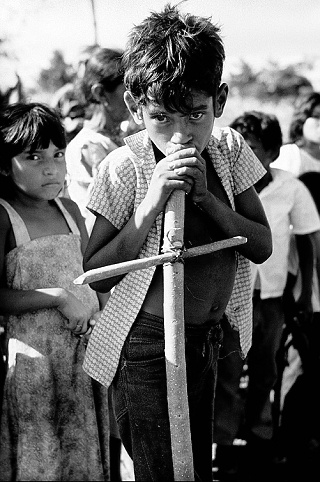
It was by chance that Daniel Erdman and Paul [Dix] (both with WFP) were in the Nueva Guinea region when Contras shot into the wooden-planked house of the Miranda family, killing 45-year-old Alejandra Miranda and her son, 17-year-old Horacio Miranda Gómez. Daniel and Paul arrived in the small community of La Esperanza to attend the wake and burial one day after the 17th of January, 1986, attack. Ten-year-old Wilfredo witnessed the death of his mother and brother. Most of the family was together the evening of the attack because Horacio,
who had been drafted into the Sandinista Army, was visiting. (Wilfredo thinks this was the reason for the attack.) Two of his brothers were wounded: Eduardo, ten, had a superficial wound on his right side, and Francisco, 16, whom they later visited in the Juigalpa hospital, had a bullet rip through his upper right arm. His two sisters: Jasmina, 12, and Edelma, 8; another brother, Marvin, 14; and his father, Victoriano, were unharmed.
At that time the family was renting a house in La Esperanza, but had a farm outside of town. After the attack they sold it for next to nothing because of the danger of working outside of town. Wilfredo says he lost everything, including his father, who later died from drinking. Wilfredo has had various jobs in Nicaragua and Costa Rica, including work with the OAS (Organization of American States) as a
zapador, locating and deactivating some of the more than 160,000 land mines left in the ground after the Contra war.
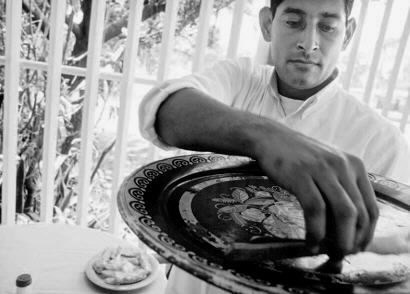
When we found him in Tipitapa, near Managua, he was working as a waiter trying to support a wife and baby daughter.
~~~
Algunas organizaciones nogubermentales, como Acción Permanente por la Paz (Witness for Peace, WFP), trataron de reportar los abusos en contra de civiles durante la Guerra Contra, pero ya que estos ataques y secuestros ocurrían casi diariamente, solamente una fracción fue reportada. Además, muchos Nicaragüenses se sentían demasiado intimidados por la Contra como para reportar los incidentes. Los medios principales de comunicación cubrían principalmente los ataques mayores o los incidentes con minas antipersonales donde morían seis o más civiles. Las numerosas atrocidades cotidianas pasaban frecuentemente desapercibidas.
Fue por casualidad que Daniel Erdman y Paul (los dos de WFP) estaban en la región de Nueva Guinea cuando los Contras dispararon a la casa de madera de la familia Miranda, y asesinaron a Alejandra Miranda, de 45 años, y a su hijo Horacio Miranda Gómez, de 17 años. Daniel y Paul llegaron a la pequeña comunidad de La Esperanza para asistir al funeral y entierro un día después del ataque del 17 de enero de 1986. Wilfredo, de 10 años, fue testigo de la muerte de su madre y hermano. La mayoría de la familia estaba reunida la tarde del ataque porque Horacio, quien había sido reclutado en el ejército Sandinista, estaba de visita. (Wilfredo piensa que esto podría haber sido la razón del ataque). Dos de sus hermanos resultaron heridos: Eduardo de 10 años, tenía una herida superficial al lado derecho y Francisco, su otro hermano de 16 años, a quien visitaron más tarde en el hospital de Juigalpa, tenía un desgarro de bala en la parte superior de su brazo derecho. Sus dos hermanas, Jasmina de 12 años y Edelma de 8 años; su otro hermano, Marvin, de 14 años; y su padre Victoriano, resultaron ilesos.
Por aquella época, la familia alquilaba una casa en La Esperanza, pero tenía una finca fuera del pueblo. Después del ataque, vendieron la finca por muy poco a causa del peligro de trabajar fuera del pueblo. Wilfredo dice que él lo perdió todo, incluso a su padre, quien con el tiempo murió de alcoholismo. Wilfredo ha tenido diferentes trabajos en Nicaragua y en Costa Rica, incluyendo la OEA (Organización de los Estados Americanos), como zapador, localizando y desactivando algunas de las más de 160,0001 minas antipersonales que quedaron en la tierra después de la guerra Contra. Cuando nos lo encontramos en Tipitapa, cerca de Managua, trabajaba de mesero, intentando mantener a su esposa y a su hijita.
The
photographer and editor of Living With The Consequences,
Paul Dix and Pam Fitzpatrick, gratefully accept gifts
in support of publishing this book in print format and
making it available to audiences around the world. Please
visit our contributions page.
|